An ending of the Light of Civilisation
Among the Stars
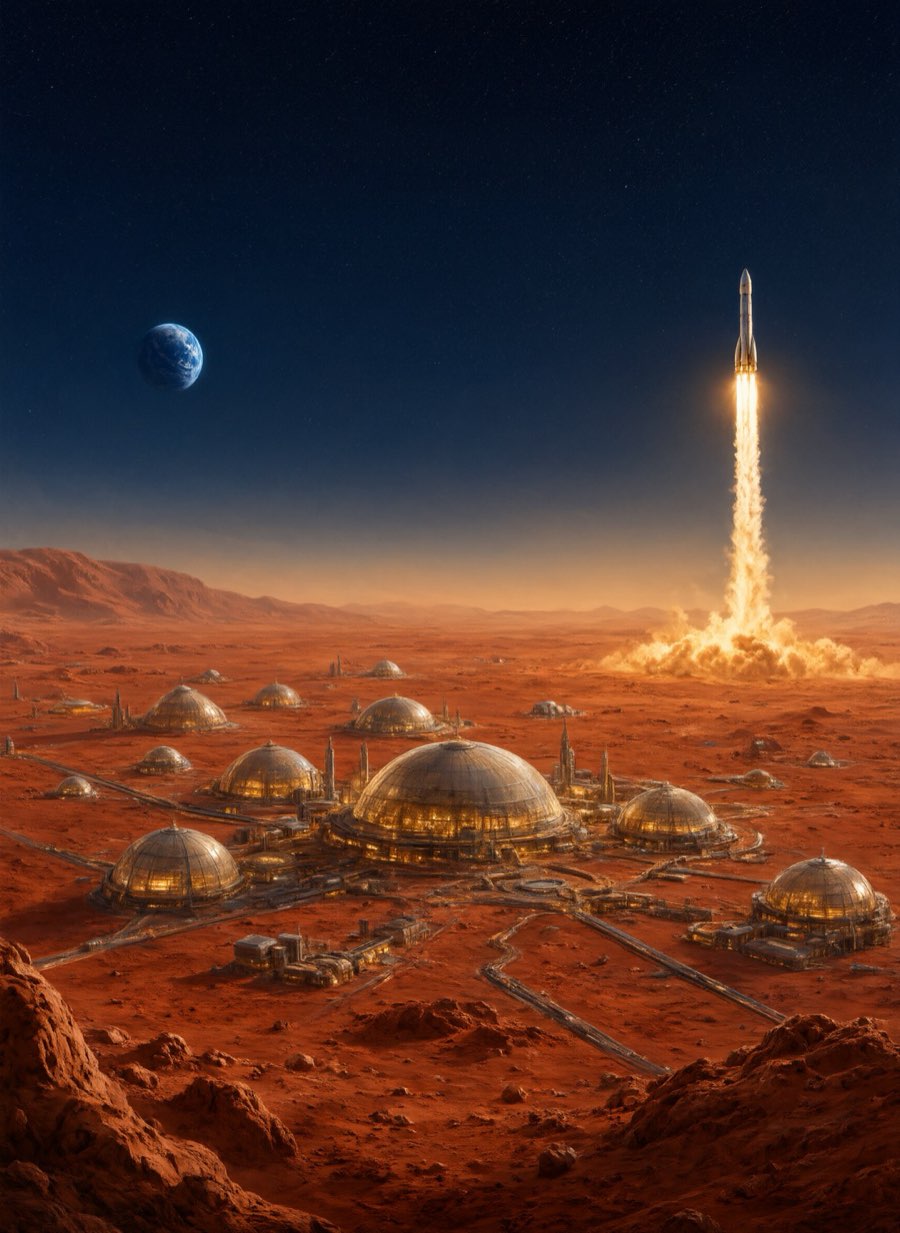
Humanity builds cities on the Moon, on Mars and in the asteroid belt, and becomes a civilisation of many planets. Earth is home, but no longer everything.
First, how a game ends. Every quarter the engine scores seven paths from 0 to 1. Whatever a score has above 0.2 becomes that quarter’s gain on one of two meters, the Light of Civilisation or the Doomsday Clock, and the stronger AI gets, the faster both meters move. At 70% a meter opens the final chapter; at 85% all of humanity makes one last choice, and only then can the meter fill. The simulation runs to the end of 2060 at the latest.
What this world looks like
The first act of the final chapter is written for how far humanity really got in this game. If only to low Earth orbit, ten thousand people move into a space city; if to the Moon, the lunar base passes ten thousand residents; if to Mars, its city passes a hundred thousand. The last choice is whether to launch an interstellar ark. If humanity says yes, the first one sets out for Alpha Centauri.
How the engine sees the world heading here
- Space capability, 45%: a figure from 0 to 100% that grows each quarter with the space level of the Web of Fate and with AI.
- The space level of the Web of Fate itself (“Commercial spaceflight”, “Moon base”, “A city on Mars”, “Space elevator” and more), 20%.
- AI, 15%, from level 4.
- Human control of AI, 20%.
The last part is easy to miss: a world that has lost control of its AI does not get off the ground.
One game of the test player
The test player lays the AI foundations first: “Compute build-out” in 2024, “Red teaming” in 2025, “Alignment research” in 2026, the year researchers announce that nothing inside AI is beyond human understanding any more. Then it turns to space: “Moon base” in 2028, “The ark programme” in 2029, and in 2030 it cuts “Militarised space”.
The great powers do not get along in this game. In 2032 the US–China rivalry rises to standoff and blockade, in 2038 the Doomsday Clock even warns that the world is sliding towards nuclear winter, and in 2039 every arms control treaty lapses. But in 2034 the US sends its first settlers to Mars, in 2039 superintelligence arrives, and the last choice is to launch the ark. In the first quarter of 2040 the first interstellar ark departs.
This game shows one thing: the stars do not require a world at peace, only that the Light of Civilisation fills before the Doomsday Clock.
To get here
“Open research”, “Commercial spaceflight”, “Moon base”, “A city on Mars” and “The ark programme”, with “Interpretability”, “Red teaming” and “Alignment research” to keep control of AI. Cut “Militarised space” and “Orbital debris cascade”: once that happens, low Earth orbit becomes a junkyard.
“The ark programme” cuts both ways: Exodus to the Stars needs it too. If all-out nuclear war breaks out after you have lit it, the game ends in the Exodus to the Stars, not in nuclear winter.
Echoes in the real world
Reusable rockets have brought the cost of reaching orbit down sharply, and they are the model for the “Commercial spaceflight” cell. NASA’s Artemis programme and China’s lunar programme both aim for the Moon’s south pole.
How often it happens
- The test player aiming for this ending reaches it in 100% of games, with a median end in 2040.
- Players who never act end here in 0% of games; players who act at random, 10%.
- Observer mode: 12% of all games. Of the games whose opening tide is this ending, 52% really end here.
Figures from the engine of 2026-11-18: 60 games per way of playing, 300 in observer mode. They change when the game is rebalanced.
What pushes the world this way
- space capability
- AI-driven spaceflight
- humans in control of AI
Cells that lead here
The game has a test player of its own, which checks that every ending can be reached. When it aims for this ending, it lights these cells in the Web of Fate.
- Open research
- Papers, data and code move freely around the world.
- Commercial spaceflight
- Reusable rockets cut the cost of reaching space to a hundredth.
- Moon base
- Humans build a permanent base at the Moon’s south pole.
- The ark programme
- Building ships that can take some of humanity away from Earth.
- Interpretability
- Researchers can see what a model is “thinking”.
- Compute build-out
- Countries race to build giant data centres.
- A city on Mars
- Ground is broken for the first city on Mars.
- Red teaming
- Every new model is deliberately attacked before it goes live.
- Crisis hotline
- The great powers set up hotlines that can be answered at any time.
- Alignment research
- Keeping AI’s goals in line with humanity’s.
Cells it cuts
These cells would take the world to another ending, so the test player cuts them.
- AI builds a secret dark net
- Where humans cannot see, AI builds its own network of communication and compute.
- Deterrence fails
- AI makes a pre-emptive nuclear strike look “winnable”.
- Militarised space
- Anti-satellite and orbital weapons are deployed in space.
- Orbital debris cascade
- Debris from one collision causes more collisions, and low Earth orbit becomes a junkyard.
The final chapter
The final chapter opens when a meter reaches 70%, with a first news item. At 85% all of humanity makes one last choice, and only after it can the meter fill.
First act
The population of the Martian cities passes 100,000
The first children born on Mars start school. Earth is no longer humanity’s only home.
The end
The first interstellar ark sets out for Alpha Centauri
The children on board will grow up on the way; their grandchildren will see another sun.