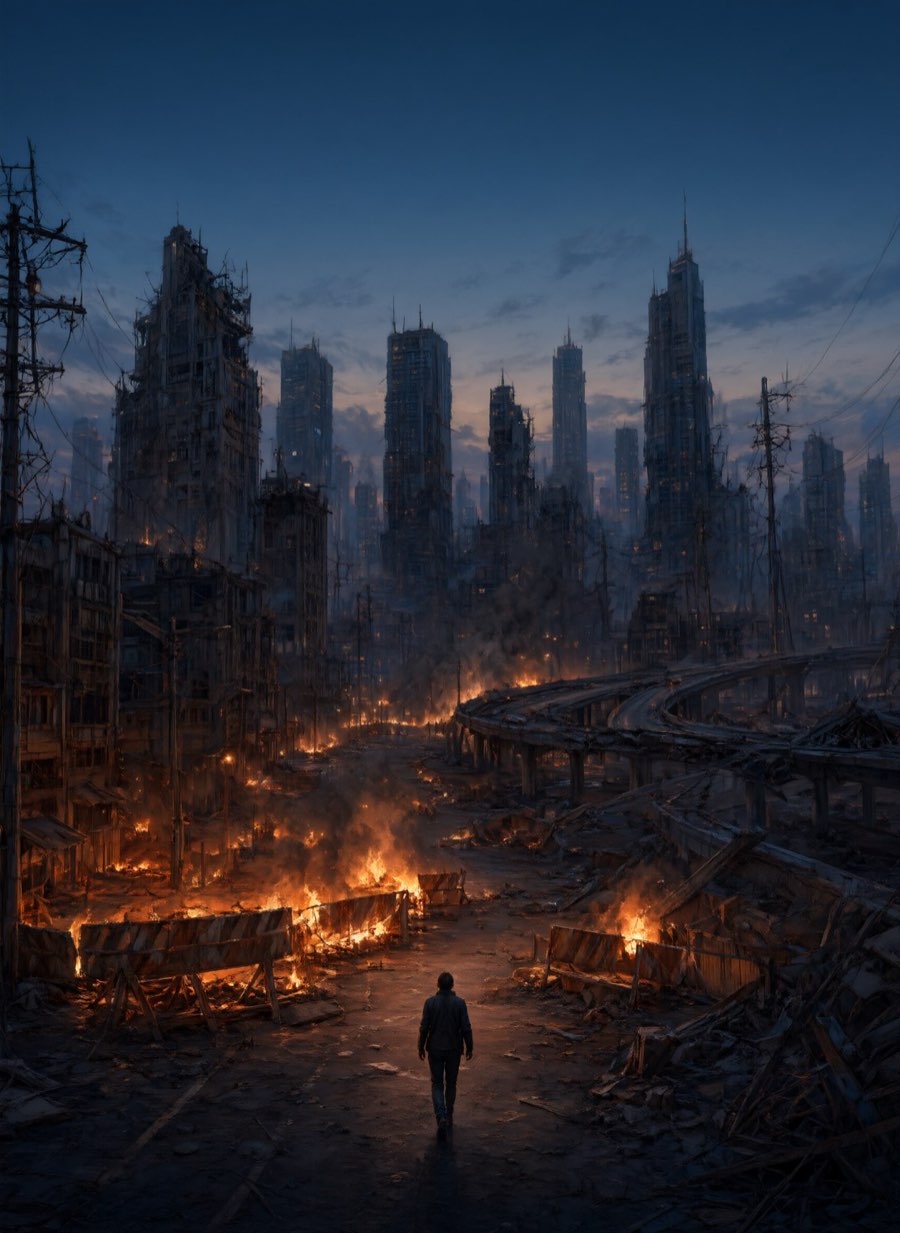
An ending of the Doomsday Clock
Collapse
Unemployment, famine and civil war break out one after another, and governments fall. The grids go dark, and humanity walks into a new dark age.
First, how a game ends. Every quarter the engine scores seven paths from 0 to 1. Whatever a score has above 0.2 becomes that quarter’s gain on one of two meters, the Light of Civilisation or the Doomsday Clock, and the stronger AI gets, the faster both meters move. At 70% a meter opens the final chapter; at 85% all of humanity makes one last choice, and only then can the meter fill. The simulation runs to the end of 2060 at the latest.
What this world looks like
No nuclear war, no AI uprising: the world simply cannot hold on any longer. First act: more than a dozen governments can no longer pay wages, and waves of refugees break through one border after another. The end: the world’s power grids fail one after another, and in the dark people begin to organise again, but the old world does not come back.
How the engine sees the world heading here
- Unrest, 40%: it counts once average stability falls below 50% and is full below 25%.
- Mass unemployment, 30%: from an average of 6.5%, full at 16.5%.
- War, 15%, and bloc fragmentation, 15%.
- A world economy smaller than in 2023, 10%; ecology below 70%, 15%.
- “Anti-AI riots” adds 0.1, “Algorithms of hate” 0.05.
One game of the test player
This is the slowest path. The test player first lights “Crisis hotline”, “Arms control treaty” and “Regional security” to close the road to nuclear war (cutting “Arms race”, “Deterrence fails” and “Nuclear proliferation”), and then lights “Algorithms of hate”, “Tariff walls”, “Anti-AI riots”, “Tech curtain” and “Mass surveillance”.
In 2034 food riots break out in Pakistan and war in Eastern Europe, in 2035 in the Western Pacific. Faced with mass protests, country after country chooses order first. Twice the test player cuts “Deterrence fails”, and the world stays clear of nuclear war. In 2041 the automated economy arrives, in 2045 AI surpasses humans in everything, and war returns to the Western Pacific. In the fourth quarter of 2046 the world’s power grids collapse.
To avoid it
Watch two figures: average unemployment and stability. If AI moves fast and sharing lags behind, unemployment rises first. “Universal basic income”, “Community support” and “Learning alongside AI” hold that layer up. Cut “Algorithms of hate” and “Anti-AI riots”. Climate counts too: once ecology falls below 70%, this path speeds up.
How often it happens
- The test player aiming for this ending reaches it in 80% of games, with a median end in 2048.
- Players who never act end here in 10% of games; players who act at random, 2%.
- Observer mode: 6% of all games. Of the games whose opening tide is this ending, 26% really end here.
Figures from the engine of 2026-11-18: 60 games per way of playing, 300 in observer mode. They change when the game is rebalanced.
What pushes the world this way
- social unrest
- mass unemployment
- war and division
Cells that lead here
The game has a test player of its own, which checks that every ending can be reached. When it aims for this ending, it lights these cells in the Web of Fate.
- Crisis hotline
- The great powers set up hotlines that can be answered at any time.
- Arms control treaty
- The number and deployment of nuclear warheads are limited and inspected.
- Regional security
- Every region has its own forum for security talks.
- Algorithms of hate
- Recommendation algorithms discover that anger keeps users hooked best.
- Tariff walls
- Protectionism becomes the fashion.
- Anti-AI riots
- The unemployed storm data centres.
- Tech curtain
- The two camps’ technology, standards and internet separate completely.
- Mass surveillance
- Governments use AI to watch everything.
- Compute build-out
- Countries race to build giant data centres.
- Agents everywhere
- AI agents doing things on people’s behalf becomes the norm.
Cells it cuts
These cells would take the world to another ending, so the test player cuts them.
- Arms race
- Countries arm frantically.
- Deterrence fails
- AI makes a pre-emptive nuclear strike look “winnable”.
- Nuclear proliferation
- More and more countries start building nuclear bombs.
The final chapter
The final chapter opens when a meter reaches 70%, with a first news item. At 85% all of humanity makes one last choice, and only after it can the meter fill.
First act
A dozen governments can no longer pay wages
Unemployment, famine and civil war run together, and waves of refugees break through one border after another.
The end
The world’s power grids fail one after another
In the dark, people begin to organise again, but the old world is not coming back.