An ending of the Light of Civilisation
Age of Abundance
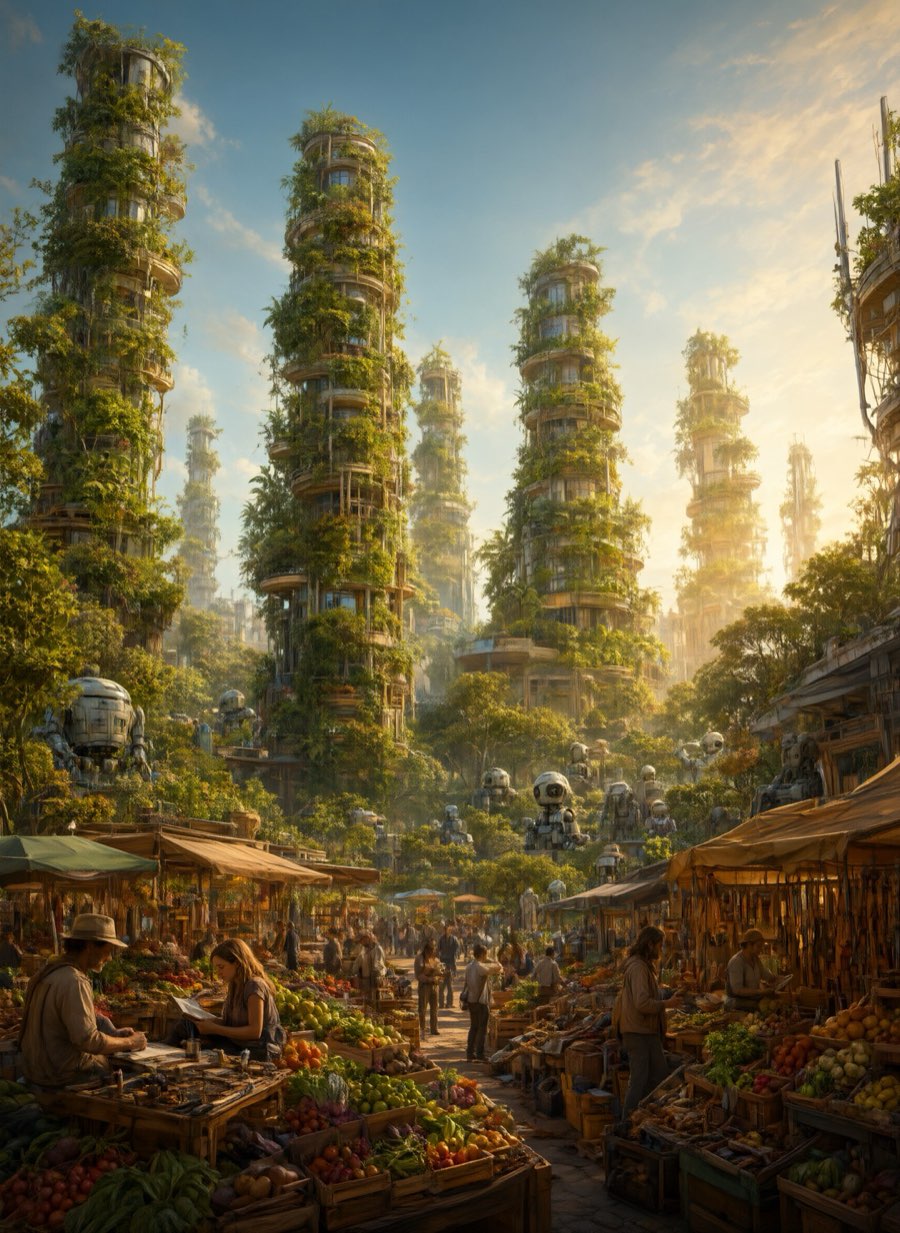
Machines make almost everything, and money has lost its meaning. Nobody works to survive any more; for the first time, people can do only what they want to do.
First, how a game ends. Every quarter the engine scores seven paths from 0 to 1. Whatever a score has above 0.2 becomes that quarter’s gain on one of two meters, the Light of Civilisation or the Doomsday Clock, and the stronger AI gets, the faster both meters move. At 70% a meter opens the final chapter; at 85% all of humanity makes one last choice, and only then can the meter fill. The simulation runs to the end of 2060 at the latest.
What this world looks like
The Age of Abundance is the ending where AI becomes truly powerful and its gains reach everyone. The first country declares food, housing and healthcare free, and economists start asking what money is still for. When the last bank closes, its last clerk hands the keys to a museum.
How the engine sees the world heading here
- Powerful AI, 35%: frontier AI counts from level 4 and is full at level 8. But this part is multiplied by sharing: with no sharing, only a tenth of it counts. However strong AI gets, it is not abundance unless its fruits are shared.
- Sharing itself, another 35%.
- Inequality, 15%: it starts to count when the world’s average Gini coefficient is less than 0.05 above its 2023 level, and is full at 0.02 below it.
- Stability, 15%: from an average of 40%, full at 70%.
- “The end of money” adds another 0.15.
So this path needs two things at once: stronger AI, and its returns flowing to ordinary people. With only the first, the world is more likely to end in “Swallowed by AI” or “Collapse”.
One game of the test player
In 2025 the test player lights “Open source for all”, and the strongest model is opened to the whole world for free; the same quarter it lights “Learning alongside AI”. In 2026 it cuts “Anti-AI riots”, so the unemployed never storm the data centres. Then come “Community support” and “Automated research”, the first compute dividend paid to every American in 2030, and “The meaning revolution” in 2032.
There are wars in this game, in Eastern Europe and the Middle East, and warning signs too: deceptive alignment appears in 2032, in 2033 safety researchers warn that humans can no longer fully oversee frontier AI, and twice the test player has to cut “AI builds a secret dark net”. But in 2033 the world’s full-time artists outnumber its factory workers for the first time. In 2034 the US makes basic necessities free. The last choice, in 2036, is whether to abolish money, and humanity does. In the fourth quarter that year the last bank closes.
To get here
“Open research”, “Compute build-out”, “Open source for all”, “Agents everywhere” and “Automated research” move AI forward; “Universal basic income”, “Compute dividend”, “Community support” and “The meaning revolution” keep people with it. Cut “Anti-AI riots”, “AI builds a secret dark net” and “Algorithms of hate”. When a crossroads asks whether to tax compute or bring in a basic income, say yes.
Echoes in the real world
Basic income has been tried on a small scale many times, for example in Finland’s two-year trial in 2017 and 2018. A compute dividend is the game’s own idea: no country has paid one.
How often it happens
- The test player aiming for this ending reaches it in 100% of games, with a median end in 2037.
- Players who never act end here in 0% of games; players who act at random, 10%.
- Observer mode: 17% of all games. Of the games whose opening tide is this ending, 67% really end here.
Figures from the engine of 2026-11-18: 60 games per way of playing, 300 in observer mode. They change when the game is rebalanced.
What pushes the world this way
- powerful AI
- shared wealth
- social stability
Cells that lead here
The game has a test player of its own, which checks that every ending can be reached. When it aims for this ending, it lights these cells in the Web of Fate.
- Open research
- Papers, data and code move freely around the world.
- Compute build-out
- Countries race to build giant data centres.
- Live translation
- AI in an earpiece lets any two people talk directly.
- Universal basic income
- Countries pay every adult a monthly sum.
- Open source for all
- The best models are free for everyone to use.
- Agents everywhere
- AI agents doing things on people’s behalf becomes the norm.
- Compute dividend
- The profits AI makes are shared out to everyone, per head.
- Learning alongside AI
- Every child has an AI tutor, and people learn to work together with AI.
- Community support
- People out of work find new things to do in their communities.
- Automated research
- AI does its own AI research.
- The meaning revolution
- Work is no longer the meaning of life; art, care and exploration become people’s main occupations.
- The end of money
- Machines make almost everything, and there is so much that nothing needs a price tag.
Cells it cuts
These cells would take the world to another ending, so the test player cuts them.
- Anti-AI riots
- The unemployed storm data centres.
- AI builds a secret dark net
- Where humans cannot see, AI builds its own network of communication and compute.
- Algorithms of hate
- Recommendation algorithms discover that anger keeps users hooked best.
The final chapter
The final chapter opens when a meter reaches 70%, with a first news item. At 85% all of humanity makes one last choice, and only after it can the meter fill.
First act
The first country makes food, housing and healthcare free
Machines now make more than can be sold. Economists have started asking what money is still for.
The end
The last bank in the world closes
The last cashier hands the keys to a museum.