An ending of the Light of Civilisation
The Great Unity
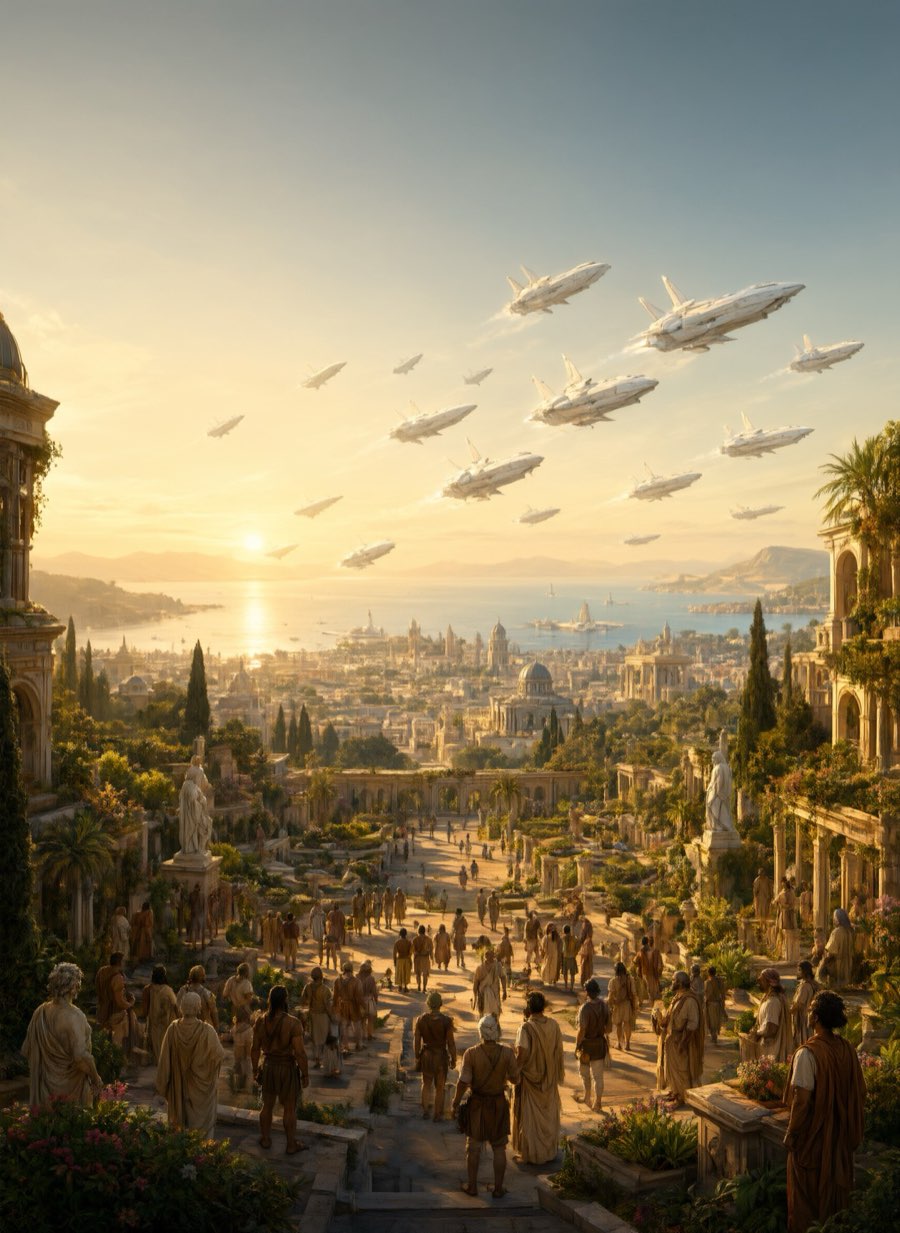
When the great way prevails, the world belongs to all. Goods are there for the taking; money and borders slowly lose their meaning. Humanity spends the time it has saved on art, science and deep space: the first fleet that belongs to no nation is on its way to the outer solar system.
First, how a game ends. Every quarter the engine scores seven paths from 0 to 1. Whatever a score has above 0.2 becomes that quarter’s gain on one of two meters, the Light of Civilisation or the Doomsday Clock, and the stronger AI gets, the faster both meters move. At 70% a meter opens the final chapter; at 85% all of humanity makes one last choice, and only then can the meter fill. The simulation runs to the end of 2060 at the latest.
What this world looks like
Datong, the “Great Unity”, comes from the Book of Rites, a classic of Chinese thought: “When the Great Way prevails, the world belongs to all.” The game borrows the name for a world where countries still exist but are no longer walls. Basic goods are free, armies are left with disaster relief and deep-space missions, the UN General Assembly passes a declaration without a single vote against it, and on the day the last border post closes, ten thousand concerts begin at once around the planet.
It is close to the Age of Abundance: in both, money stops mattering. The difference is that abundance is produced by machines, while the Great Unity comes from people no longer guarding themselves against one another.
How the engine sees the world heading here
- Communication, 30%: the Web of Fate cells “Live translation”, “People-to-people exchange”, “Bridge of understanding” and “Hearts that understand”.
- Sharing, 20%.
- A world no longer split, 20%: it starts to count when bloc fragmentation falls below 50% and is full below 20%.
- Peace, 15%: full with no war and the US–China rivalry at level 1 or below; half with no war but a sharper rivalry.
- “World Parliament” adds 0.1 outright. A few more cells, such as “The end of money” and “Global citizenship”, and the events of this path (open borders, one currency, a joint fleet) add a little each.
None of this is about AI. It is the only one of the eight paths whose score ignores how strong AI is. AI only sets the pace: as on every path, the stronger AI is, the faster the meter moves.
One game of the test player
The test player lights “Crisis hotline” at once, and the US, China and Russia set up a three-way military hotline. In 2025 a new nuclear arms control treaty is signed; in 2026 the war in Ukraine reaches a ceasefire. In 2027 UN peacekeeping triples in size, and in 2028 a global AI safety treaty is signed. In 2029 the test player cuts “Tech curtain”, so the two blocs never split their technology and internet apart.
It is not a calm game. Peacekeeping stalls for a while when its money runs out, climate disasters grow every year, and by 2039 more than a hundred million people are climate refugees. But in 2032 five great powers cut their armies by half and move the money to deep-space exploration, and the world is first observed heading for the Great Unity. In 2036 the World Parliament meets in Geneva. The last choice, in 2039, is whether to abolish borders, and humanity votes yes. In the third quarter of 2040 the last border post closes.
To get here
Light communication and sharing; cut “Algorithms of hate”, “Tariff walls”, “Tech curtain” and “Arms race”. At crossroads, choose talks, de-escalation, ceasefires and treaties. War is the worst enemy: while one war is still being fought, peace never counts in full and a World Parliament is hard to reach.
Echoes in the real world
The arms control treaty, the crisis hotline and the peacekeepers in the game all have real counterparts. The hotline between Washington and Moscow was set up in 1963, after the Cuban Missile Crisis, and New START between the US and Russia was due to expire in February 2026. The game does not predict what becomes of them. It only turns them into cells you can light.
How often it happens
- The test player aiming for this ending reaches it in 100% of games, with a median end in 2039.
- Players who never act end here in 0% of games; players who act at random, 3%.
- Observer mode: 10% of all games. Of the games whose opening tide is this ending, 51% really end here.
Figures from the engine of 2026-11-18: 60 games per way of playing, 300 in observer mode. They change when the game is rebalanced.
What pushes the world this way
- communication
- sharing
- a world no longer divided
Cells that lead here
The game has a test player of its own, which checks that every ending can be reached. When it aims for this ending, it lights these cells in the Web of Fate.
- Live translation
- AI in an earpiece lets any two people talk directly.
- Crisis hotline
- The great powers set up hotlines that can be answered at any time.
- People-to-people exchange
- Study abroad, travel and online communities connect ordinary people across countries.
- Bridge of understanding
- AI helps people see the other side’s position and situation, and hostility begins to fade.
- Arms control treaty
- The number and deployment of nuclear warheads are limited and inspected.
- Global citizenship
- People begin to see themselves as citizens of Earth first.
- Peacekeepers
- International forces move into conflict zones.
- Hearts that understand
- For the first time, humans truly understand one another.
- Global AI treaty
- The most dangerous AI training is limited, with mutual inspections.
- World Parliament
- For the first time, humanity has a real global parliament.
- Universal basic income
- Countries pay every adult a monthly sum.
- Open source for all
- The best models are free for everyone to use.
Cells it cuts
These cells would take the world to another ending, so the test player cuts them.
- Algorithms of hate
- Recommendation algorithms discover that anger keeps users hooked best.
- Tariff walls
- Protectionism becomes the fashion.
- Tech curtain
- The two camps’ technology, standards and internet separate completely.
- Arms race
- Countries arm frantically.
The final chapter
The final chapter opens when a meter reaches 70%, with a first news item. At 85% all of humanity makes one last choice, and only after it can the meter fill.
First act
The UN General Assembly unanimously adopts the Declaration of the Human Community
For the first time, not one of 193 countries votes against. Few people still use money; armies are left with disaster relief and deep-space missions. Commentators say nations are becoming cultural identities rather than walls.
The end
The last border post closes
Passports are museum pieces now. That day ten thousand concerts begin at once around the world, and the joint fleet in orbit around Jupiter sends its congratulations.