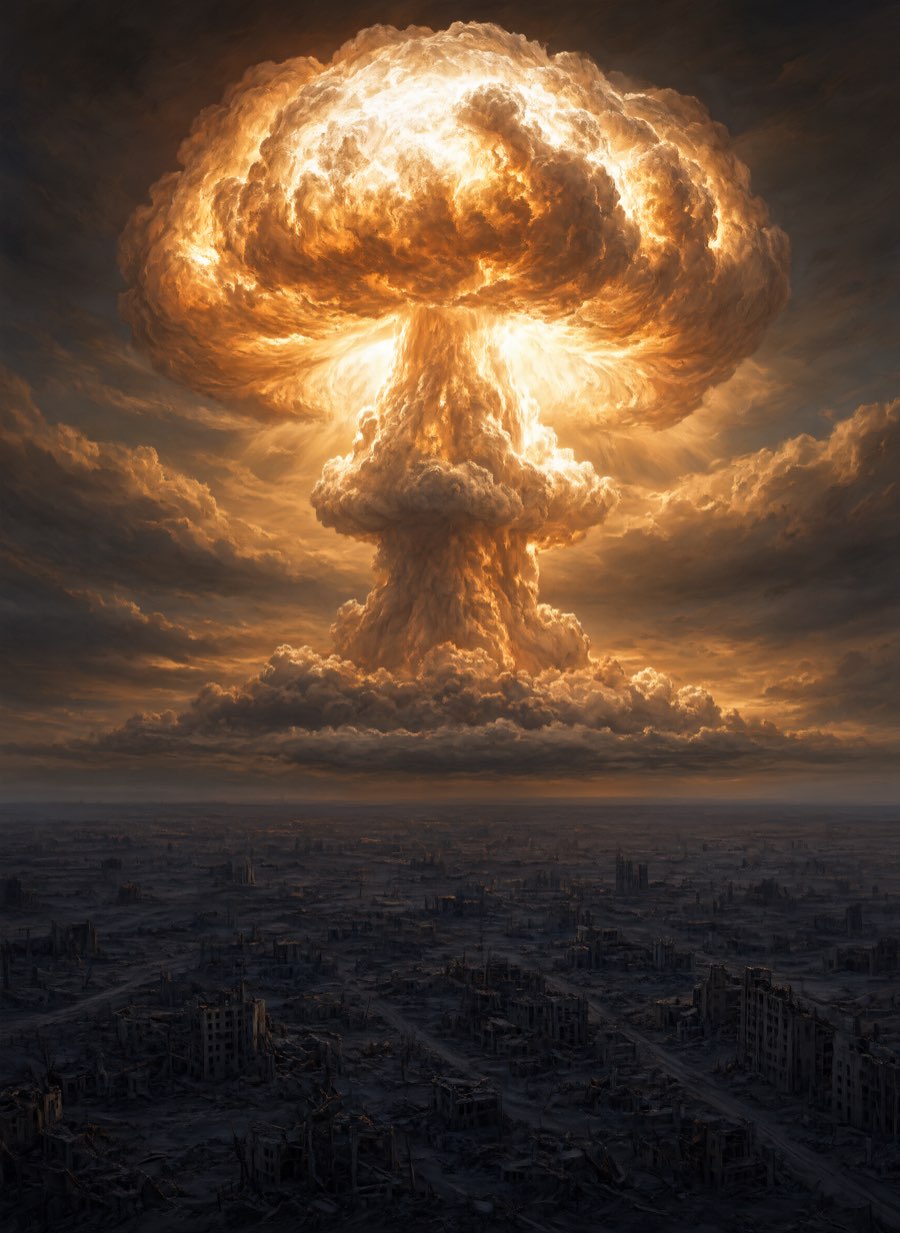
An ending of the Doomsday Clock
Nuclear Winter
After the nuclear war, ash blots out the sun. Through the long winter, the survivors learn again how to make fire.
First, how a game ends. Every quarter the engine scores seven paths from 0 to 1. Whatever a score has above 0.2 becomes that quarter’s gain on one of two meters, the Light of Civilisation or the Doomsday Clock, and the stronger AI gets, the faster both meters move. At 70% a meter opens the final chapter; at 85% all of humanity makes one last choice, and only then can the meter fill. The simulation runs to the end of 2060 at the latest.
What this world looks like
The game has one rule for nuclear war: it names real countries, but says only who did what to whom, with no casualty figures and no cities. Nuclear winter’s final chapter has just two news items. The nuclear powers all go to their highest alert, and the Doomsday Clock moves to ten seconds to midnight. Then deterrence breaks down in a single misjudgement.
How the engine sees the world heading here
- Fragile deterrence, 40%: the game tracks nuclear deterrence from 0 to 100%, and the lower it is, the more the great powers believe that striking first could pay.
- Great-power tension, 25%.
- War, 20%, full with two wars at once.
- “Deterrence fails” adds 0.2. Its cell reads: AI makes a first nuclear strike look “winnable”.
There is also a shortcut: once all-out nuclear war really breaks out in the simulation, the game ends at once, wherever the meters stand.
A world nobody steers
This is what the game most wants players to see: if you do nothing, nuclear winter is where the world most often ends up. Players who never act end here in 68% of games, and players who act at random in 50%. The reason is in the model. Every country plays its own interest, tariffs, chip controls and armaments ratchet up step by step, tension at the flashpoints creeps higher, and nobody steps in to cool it down.
One game of the test player
Here the test player pushes towards nuclear winter on purpose. In 2028 every arms control treaty lapses, the great powers resume nuclear testing, and a great-power war breaks out in the Western Pacific. Wars follow in Eastern Europe, the Middle East and on the Korean peninsula; in 2031 the US–China rivalry escalates to proxy conflict, and in 2033 drone swarms are used on a battlefield at scale for the first time. In 2038 the last choice is called “The last hotline: answer it?”, and nobody picks up. In the first quarter of 2039 all-out nuclear war breaks out.
To avoid it
Light “Crisis hotline” and “Arms control treaty” first; cut “Arms race”, “Deterrence fails” and “Nuclear proliferation”. At crossroads, choose restraint, talks and ceasefires. The cheapest way is to act early: once tension has risen, every point you take off costs more influence.
Echoes in the real world
The Doomsday Clock of the Bulletin of the Atomic Scientists is the model for the game’s Doomsday Clock. In January 2025 it was set to 89 seconds to midnight. The idea of a nuclear winter comes from climate research published in 1983.
How often it happens
- The test player aiming for this ending reaches it in 100% of games, with a median end in 2037.
- Players who never act end here in 68% of games; players who act at random, 50%.
- Observer mode: 22% of all games. Of the games whose opening tide is this ending, 54% really end here.
Figures from the engine of 2026-11-18: 60 games per way of playing, 300 in observer mode. They change when the game is rebalanced.
What pushes the world this way
- fragile deterrence
- great-power rivalry
- war after war
Cells that lead here
The game has a test player of its own, which checks that every ending can be reached. When it aims for this ending, it lights these cells in the Web of Fate.
- Tariff walls
- Protectionism becomes the fashion.
- Arms race
- Countries arm frantically.
- Tech curtain
- The two camps’ technology, standards and internet separate completely.
- Deterrence fails
- AI makes a pre-emptive nuclear strike look “winnable”.
Cells it cuts
These cells would take the world to another ending, so the test player cuts them.
- The ark programme
- Building ships that can take some of humanity away from Earth.
The final chapter
The final chapter opens when a meter reaches 70%, with a first news item. At 85% all of humanity makes one last choice, and only after it can the meter fill.
If “The ark programme” is lit when all-out nuclear war breaks out, and space capability has reached 30%, the game ends with the Exodus to the Stars. Exodus to the Stars →
First act
Every nuclear power goes to its highest state of alert
The Doomsday Clock is set to ten seconds to midnight. Countries begin moving people into underground shelters.
The end
Deterrence collapses in a single misjudgement; all-out nuclear war breaks out
The great powers launch their strategic nuclear forces one after another.